DesignBuilder Software -- Building Performance Simulation (VB6)
 DesignBuilder Software Ltd is a UK-based software developer dedicated to bringing advanced building performance simulation within reach of practitioners across architecture, engineering and energy assessment. Founded to simplify the path from conceptual design to environmental performance optimization, DesignBuilder’s solutions enable users to model, simulate and analyse the energy, comfort, daylighting, HVAC and whole-life-cost outcomes of buildings with far less friction than traditional tools.
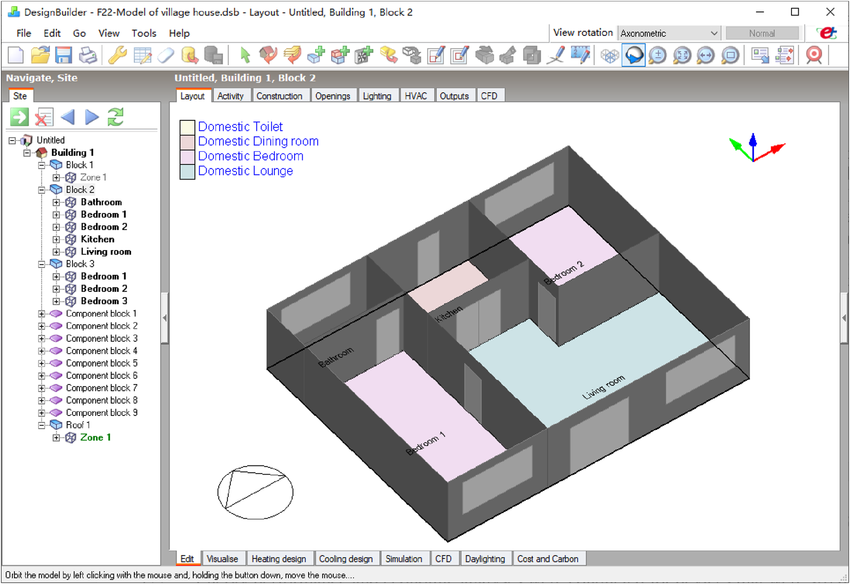
At the heart of the company’s offering is the flagship product DesignBuilder, a graphical, intuitive environment built around the proven simulation engine EnergyPlus. The product represented more than 20 years of investment and supports a wide range of modules that allow users to both design and verify building performance:
|  |
|---|
The DesignBuilder codebase was comprised of 5 inter-related VB6 projects referencing 657 VB6 source files containing approximately 550,000 lines of code and using 46 COM libraries and components.
DesignBuilder worked with GM to reproduce the product in C#/.NET in a manner that precisely preserved the domain-specific functional depth, performance, and user experience. The project employed the Transform and Assemble methodology: GM prepared a translation of the legacy system then the DesignBuilder team used this as a starting point for a fully optimized functionally equivalent C#-based implementation. The translation included several customizations such as retaining type Short for Integer and strengthening the weakly typed elements of the object model. The result was build-complete, organized into a Visual Studio solution, and ready for refactoring and further development by the DesignBuilder team.
GM developed the initial translations in about 8 weeks and also provided updated translations several time over the course of the project to facilitate keeping the emerging .NET code in sync with changing VB6 codes.
DesignBuilder Testimonial: Navigating the Complex Migration of 500,000+ LOC
The Challenge
Our core modeling and simulation application required a fundamental technology refresh: a massive migration from VB6 to C#/.NET and WinForms. This was not a simple port; the project involved translating over half a million lines of core modeling logic across two fundamentally unalike technology paradigms.
Our key objectives were ambitious and non-negotiable:
- Deliver a functionally indistinguishable port in C#.
- Achieve equal or better performance speed.
- Eliminate the poor memory management of the legacy VB6 runtime.
- Ensure immediate readiness for a straightforward upgrade to 64-bit as well as .NET Standard.
Choosing the Right Partner
A successful migration was vital to bridge the gap between two major product releases. We needed a partner whose tooling and expertise could handle the complexity of the legacy code, allowing us to take the translated code in-house for post-translation integration and modernization. After evaluating several solution providers, we found Great Migrations to be the right fit.
Successes and Overcoming Hurdles
The quality of the initial automated translation was immediately evident. Our first major milestone - achieving a building energy simulation via the command line - was successful, delivering identical results to the legacy VB6 product. This success validated the technical precision of the migration process.
However, the migration wasn’t without its challenges, and one of the biggest hurdles was addressing the WinForms User Interface (UI). The UI’s behavior, interactions, and visibility rules had been intricately programmed in VB6. Simply doing a UI re-write would have pulled apart too much code.
The expertise at Great Migrations was vital. They developed bespoke translation rules to handle occasional peculiar requirements, enabling us to avoid costly UI re-writes and finally get away from the “black art” of arcane Win32 calls used for toolbars, menus etc.
On receipt of the migrated code we successfully put in place replacements for all old COM components, achieving independence from the VB6 runtime. Since then we have upgraded the entire application to .NET 64-bit - fulfilling a long-term company ambition.
Conclusion
The decision between a migration and a complete re-write was tough, but migration was considered to be the best path forward for preserving our extensive modeling logic. Great Migrations’ outstanding tooling, professional support, and commitment ensured we could manage our finite staff resources effectively and stay on track. We are now merging the latest translation and are on schedule to phase in the successor application over the coming months. The VB6 to C# translation was the right choice for our technology refresh, and we highly recommend Great Migrations for their technical competence and reliability.
Simon Allen Software Development Manager, DesignBuilder Software October 2025
Gary Ross, our VP, Customer Success interviewed Simon. The transcript is below:
- Other than what you mentioned below, is there any other measurable impact that gmStudio had on your modernization project (speed, accuracy, team productivity, etc.)?
- Overall speed… There is no comparison between automating the translation and trying to do it by hand
- How would you describe your overall experience using gmStudio during the translation and merge process?
- While it seems a complicated piece of software, as it was pre-configured for our use case, the process of using and migrating our code was quite seamless, straight forward and quick
- Would you recommend Great Migrations and gmStudio to other teams modernizing legacy code? If so, why?
- Yes, GM made this process quick and simple and reduced most of the development time to migrate the code
We completed merge work this week, so just a slight update:
“We were impressed by gmStudio’s handling of a large and complex legacy codebase. The tool produced clean, maintainable translations and allowed us to iterate quickly with additional translation runs as required. With only two engineers performing the merge work, we processed our 650-file codebase in 21 work days. gmStudio materially improved the efficiency and predictability of our modernization process.”