Methodology
Overview - The Tool-Assisted Rewrite
Section titled “Overview - The Tool-Assisted Rewrite”The Great Migrations Methodology (GMM) is designed to migrate VB6/ASP applications to .NET and do so in a way that is “agile”: producing valuable results very quickly and facilitating predictable, incremental quality improvement through an iterative process we call “translation tuning”.
✅ Agile ✅ Iterative ✅ Scalable ✅ Repeatable ✅ Measurable ✅ Improvable | 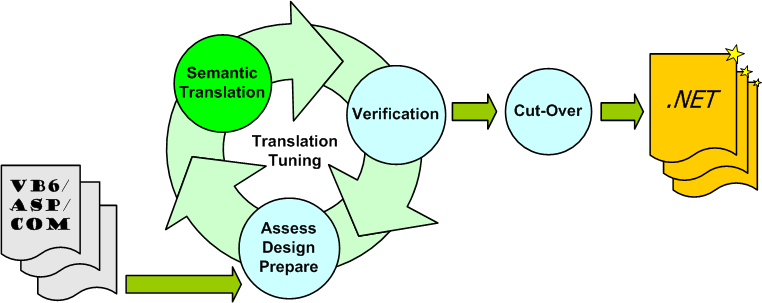 |
Each iteration has the following steps: Preparation, Migration, and Verification.
Preparation means capturing your migration requirements in the tool’s configuration. At a minimum, Preparation is three tasks:
- Specifying the location of the legacy code that you want to upgrade
- Specifying the .NET language to which you want to upgrade (C# or VB.NET) — our default is C#.
- Specifying the version of .NET framework and IDE you want to use. This may be selected in the UI of specified manually in your translation rules.
Translation (aka Migration, aka Tool-Assisted Re-Writing) means using the tool to produce an upgraded version of the legacy code that is written in a chosen language and compatible with the target platform.
Verification means determining how well the translation meets your requirements and deciding if you should do another iteration by tool or finish the task by hand.
The Preparation, Translation and Verification steps are done several times each time refining the design of the target application and the conversion process. The process of moving from the proverbial “first translation” into iterative “translation tuning” is a smooth one as the initial preparation work sets up your migration workspace and produces the baseline scripts that you can refine in subsequent tuning cycles.
Cut-Over means doing your final translation of the source codebase. When the team decides that the conversion process results are “good enough” and the only issues left are those that were determined to be easier to fix by hand, they do a final translation. This is followed by a short Fit & Finish phase to certify the new system and deploy it to production.
A Phased Approach
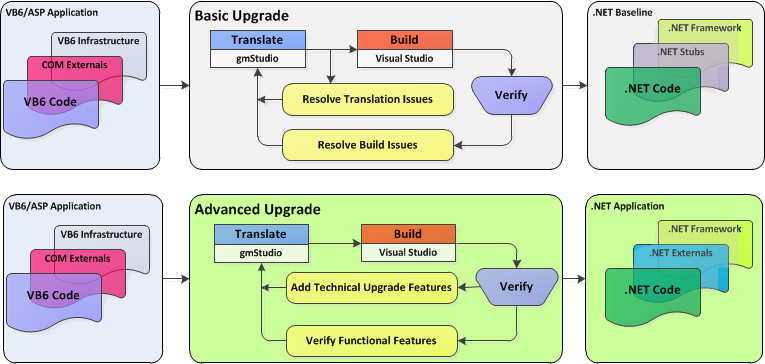
Section titled “A Phased Approach”It is common to divide a tool-assisted rewrite into three Phases:
- Standard Upgrade, producing a “direct” translation of the legacy code that builds in .NET that is ready to be modernized and refactored
- Custom Upgrade, producing a custom version of the translated code that satisfies specific technical requirements and is ready to be debugged and tested
- Verification, producing a system that is verified to satisfy functional requirements; verification is often done iteratively while fine-tuning technical upgrade features
Beyond the Conversion
Section titled “Beyond the Conversion”In practice, a serious .NET adoption effort requires much more than running a tool. For example, preparation typically includes defining architecture and development standards and developing or acquiring new architecture components. Likewise, verification typically includes proving functional correctness (through systematic regression testing), checking conformance to new standards (through code reviews), and ensuring production readiness (through various technical tests). Finally, translation typically goes well beyond the proverbial “straight conversion” to include extensive automated restructuring, incorporation of hand written code, and replacement of legacy APIs and COM components with .NET equivalents or upgrades.
gmStudio was specifically designed to help you go “beyond the conversion” It is flexible and customizable with respect to translation and it is comprehensive with respect to preparation and verification. Our intent is to offer a product that dramatically reduces the cost, risk and disruption of large, technically ambitious efforts to rewrite VB6/ASP/COM software to take full advantage of .NET.
Going End to End
Section titled “Going End to End”The discussion above is very focused on technical code transformation, but there is a lot more to an upgrade project than just rewriting code for a new platform. Specifically, testing and devops processes also require a significant definition, validation, and implementation before the new system can move into test and production environments. Our full project methodology is organized into five “super-tasks”:
 Initiation: gathering and analysing information on the AS-IS, TO-BE, and HOW factors for the upgrade project and preparing a new system blueprint and project plan that documents scope, schedule, resources and tasks.
Test Plan Development: documenting and validating setup, deployment, and testing procedures for required functionality. The updated legacy system, LeadView.VB6, is used to help document the expected results and validate all test procedures providing a finite functional scope for the project and providing a means to measure the work of a comprehensive Regression Test.
Upgrade Solution Development: developing technical requirements and implementing an Upgrade Solution that transforms the legacy functionality to a form that is ready for testing on the .NET platform. In addition, this super-task includes developing the DevOps procedures and installers for reliably and efficiently building and deploying new system releases into Dev and Test environments.
Refinement: using the testing and DevOps procedures developed in prior tasks, incrementally verifying, fixing, and optimizing the .NET code to the point where it passes all documented and validated test cases in new environments. The deliverable is a functionally verified version of the system plus all development and delivery processes that are ready to support productive, efficient user acceptance testing in customer environments.
Transition: publishing and supporting the new system in higher environments and bringing the cycle to an official closure.